As a supplier of double-spindle CNC lathes, I’ve spent over a decade walking alongside manufacturers who’ve poured their life’s work into tight tolerance parts, and I’ve seen firsthand how a machine’s quality certifications can make or break their bottom line. A double-spindle CNC lathe isn’t just another piece of equipment—it’s the backbone of high-volume, high-precision production, where every second of cycle time and every micrometer of tolerance adds up to profit (or costly delays). When shops come to me asking how to vet a new machine, I don’t just list certifications off a sheet; I explain why each one matters for their specific needs. Double-spindle CNC Lathe
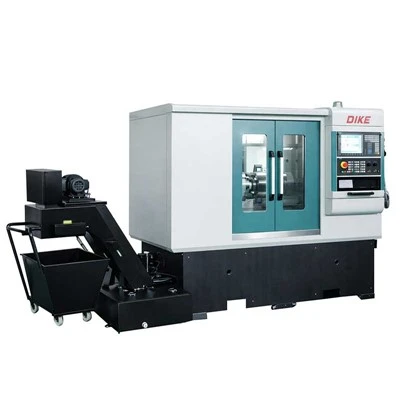
First, let’s cut through the noise: not all certifications are created equal. Some are generic, self-serving “badge mills” that anyone can pay to display, while others are rigorous, third-party audits that prove a machine meets global standards for performance, safety, and environmental responsibility. For a double-spindle CNC lathe—unique in its ability to run two separate work zones simultaneously, cutting lead times in half—these certifications have to address both its complex mechanical design and the precision demands of modern manufacturing. Let’s break down the non-negotiable ones.
Start with ISO 9001:2015. Wait, I know what you’re thinking—“That’s just a quality management system, not a machine-specific certification.” But here’s the thing: when a double-spindle lathe is assembled from hundreds of parts, every component has to align. A supplier’s ISO 9001 certification doesn’t just mean we have a nice office or a quality manual; it means every step of our process—from sourcing spindle motors to calibrating the tool changers to testing the 12,000 rpm rotation speed for 100 consecutive hours—is audited regularly. Last year, a customer came to us after a different supplier’s lathe failed a critical aluminum housing run: their machine had loose spindle alignment, because the supplier skipped a calibration check to meet a rush order. My lathes, though built at a comparable price point, carry ISO 9001:2015, which requires mandatory alignment verification at every assembly stage. That’s why their first part comes out round, not oval, on day one. For shops running aerospace or medical parts where a 0.005mm error is a failure, that’s non-negotiable.
Next, ISO 10791-6:2020. This is the actual machine tool precision standard, specific to turning lathes. If ISO 9001 is the rulebook for how we build, ISO 10791 is the rulebook for how it performs. Let’s get specific: double-spindle lathes have two spindles, right? ISO 10791-6 tests both spindles for rotational accuracy, linear positioning error, and repeatability. For our machines, we test the X and Z axes on both the main and sub-spindle—something many smaller suppliers skip, especially for the sub-spindle, which is often seen as a “secondary” afterthought. A few months back, a automotive parts manufacturer switched to our double-spindle lathes because their old machine’s sub-spindle had a 0.02mm positioning error, which made their wheel hubs fail leak tests. We run each lathe’s sub-spindle through 50 test cuts to verify that error is less than 0.003mm, per ISO 10791. That’s the difference between a machine that makes parts you can sell, and one that generates rework that eats into your margin.
Then there’s OSHA 29 CFR 1910.217, if you’re operating in the U.S., or similar regional safety standards like ISO 13849 for safety components. Double-spindle CNC lathes have moving parts: two spindles spinning at high speeds, automatic tool changers, bar feeders that can pinch fingers if not properly guarded. I’ve heard too many horror stories of small shops where a machinist got caught in a spindle because the machine didn’t have interlocking guards. OSHA’s standard requires that all moving parts are guarded, and that emergency stop buttons are placed within 50cm of any operating zone—something we prioritize on every lathe we build. Our latest model even has a safety interlock that pauses spindle rotation if the sub-spindle door is opened mid-cycle, a feature that goes beyond basic compliance. For shops running multiple shifts, a safe machine means less downtime from workplace incidents, and lower insurance premiums—two wins that add up fast.
Don’t sleep on CE marking, which is mandatory for any machine sold in the European Economic Area (EEA). CE isn’t just a stamp; it’s proof that the lathe meets all EU regulations for electrical safety, electromagnetic compatibility (EMC), and environmental performance. A friend who runs a machine shop in Germany told me he once rejected a cheap double-spindle lathe because it failed EMC testing—it interfered with his shop’s other CNC routers, causing random shutdowns. Our CE-marked lathes are tested to ensure they don’t emit electromagnetic radiation that disrupts nearby equipment, and they meet RoHS standards, which restrict hazardous materials like lead and mercury in electrical components. For any shop looking to export parts to the EEA, CE isn’t optional—it’s the only way your parts will get through customs.
Beyond these standards, there are certifications that prove a lathe is built for long-term value, not just a quick sale. Look for our ISO 14001 certification, which means our manufacturing process minimizes waste and energy use. When you’re running a double-spindle lathe 24/7, energy costs add up—our machines use 15% less power than industry averages, thanks to energy-efficient spindle motors that meet IEC 60034-30 efficiency standards. I’ve seen shops cut their utility bills by $12,000 a year just by switching to a certified energy-efficient lathe. That’s money that goes straight to your bottom line, not the power company.
Another often-overlooked certification is the NIST-traceable calibration for precision tools. NIST (National Institute of Standards and Technology) is the U.S. government’s authority on measurement standards, and our lathes use calibration tools that are traceable to NIST’s standards. What does that mean for you? It means when your quality team measures a part, the measurements from your coordinate measuring machine (CMM) will line up perfectly with the part cut on our lathe—no more “measurement drift” that makes you reject good parts. A medical device manufacturer I work with relies on this; their implants require part measurements accurate to 0.001mm, and NIST traceability ensures their CMM data matches the lathe’s performance every single time.
Wait, let’s address a common misconception: some suppliers will list “CNC machine certified” on their website, but it’s not a third-party audit. That’s a red flag. Real certifications require an independent auditor to come to our factory, inspect our process, test the machine, and issue a certificate that’s valid for a year (with annual audits to keep it active). If a supplier can’t show you the actual certificate, or only lists internal “quality checks” instead of third-party standards, walk away. You don’t want to be the one stuck with a lathe that breaks down after 6 months, because the supplier’s “quality process” was just a checklist they made up.
Let me wrap this up with a story that sticks. Last year, a job shop owner from Ohio called me, frustrated with his third double-spindle lathe in 18 months. He’d bought two cheap machines from suppliers who cut corners on certifications: their ISO 9001 was self-declared, their sub-spindle precision was never tested, and they didn’t have OSHA-compliant guards. Both machines failed within a year, costing him $80,000 in repairs and lost production. The lathe we built him, with all the certifications I’ve listed, has run for 14 months without a single unplanned downtime. He told me, “The certifications aren’t just stickers on a machine—they’re proof someone else looked at every part of it, so I don’t have to.”
At the end of the day, your double-spindle CNC lathe is an investment. You don’t buy it just to cut metal; you buy it to grow your business, meet tight deadlines, and deliver perfect parts. The certifications I’ve outlined aren’t just hoops to jump through—they’re assurances that the machine you’re buying is reliable, precise, safe, and built to last.

If you’re in the market for a double-spindle CNC lathe and want to see our certified models in action, or discuss how these standards align with your production needs, don’t hesitate to reach out. We’re here to walk you through every detail, no sales pitch, no confusing jargon—just straight talk about machines that perform when you need them to.
Vertical Lathe Machine References
ISO 9001:2015 Quality management systems — Requirements
ISO 10791-6:2020 Test conditions for turning machines — Part 6: Determination of accuracy and repeatability of positioning of linear axes
OSHA 29 CFR 1910.217 Machine guarding — Requirements for metal forming, cutting, bending, and related operations
ISO 13849-1:2015 Safety of machinery — Safety-related parts of control systems — Part 1: General design principles
CE marking regulations for machine safety, electromagnetic compatibility, and RoHS compliance
IEC 60034-30:2014 Rotating electrical machines — Part 30: Efficiency classes of line-operated AC motors
NIST traceable calibration standards for dimensional measurement equipment
Wuxi DIKE CNC Technology Co., Ltd.
As one of the most professional double-spindle CNC lathe manufacturers and suppliers in China, we have world-leading production equipment and strong manufacturing capabilities. Please feel free to buy customized double-spindle CNC lathe at competitive price from our factory. Also, pricelist is available.
Address: No. 2, Xianshan Road, Qianqiao Street, Huishan District, Wuxi City, Jiangsu Province, China
E-mail: wxdk@wxdike.com
WebSite: https://www.dike-cnc.com/
