If you’ve ever walked the floor of a welded tube manufacturing plant, you know how often old equipment sparks debates about what it can (and can’t) pull off. Last month, a regular customer of ours – a small fabricator that makes everything from automotive chassis parts to custom railings – stopped by our office with a question that didn’t feel like a standard order inquiry: “We’ve had our round tube line for 12 years, but we need square tubes now. Can we modify our existing line, or do we have to buy something new?” It’s a question I’ve heard at least half a dozen times this year, and it’s one that gets to the heart of what we do as a welded tube production line supplier: not just selling machines, but solving real, site-specific problems for fabricators who can’t afford to shut down production to pivot. Welded Tube Production Lines
For years, the industry has drawn a pretty hard line: round tube lines make round tubes, and you need a dedicated square or rectangular line for profile shapes. That’s true for lines built before 2005, when digital control and flexible roll forming were still niche technologies. But modern welded tube production lines – the ones we design and build here, with modular tooling and programmable controls – blur that line completely. The short answer to “Can a welded tube production line produce square tubes?” is: yes, absolutely. But the longer answer is where the real value lies, because not every line is built to make that switch easy, or cost-effective.
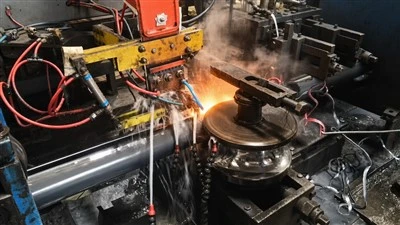
Let’s start with how welded tube production works, because that’s the foundation of every possible shape change. A standard line takes a coil of carbon steel, stainless steel, or even aluminum, feeds it through a series of uncoilers and levelers to straighten the flat steel strip, then pulls it into a forming section where a set of rotating rolls bend the strip gradually from flat into a tubular shape. The edges of the strip come together at a weld point, where a high-frequency (HF) welder or laser welder fuses them into a continuous tube. From there, the tube goes through a sizer to refine its dimensions, a straightener to remove any warping from welding, and a cut-off saw to trim it into finished lengths.
For round tubes, the forming rolls are circular – each roll set is shaped to bend the strip into a uniform round profile, with consistent diameter tolerances across the entire length of the tube. Square and rectangular tubes, though, have four sharp corners, and that’s where the old-school lines hit a wall. Traditional lines have fixed, single-purpose roll sets that are ground and machined for exactly one profile: 2-inch round, 4-inch square, whatever. If you wanted to switch, you had to yank out every roll set, retool the entire forming section, calibrate the weld point, and then test run dozens of test pieces until the dimensions were right – a process that could take three days, cost thousands of dollars in new tooling, and keep your line idle.
Modern welded tube production lines change that by using modular, quick-change tooling. Let’s break down what that looks like for square tubes specifically. First, the forming section: instead of fixed round rolls, we design the forming stands to accept interchangeable roll sets tailored for square or rectangular profiles. The key here is that the roll sets for square tubes have machined corners that are precise, so when the strip bends, it forms sharp, consistent 90-degree angles without warping or uneven wall thickness. We also build the stands with adjustable gaps, so the distance between rolls can be fine-tuned in minutes, not hours, to match different square tube dimensions – from 1-inch square up to 10-inch square, depending on the line’s capacity.
But forming is only half the battle for square tubes. Welding is the other part, because square tubes have a different seam profile than round tubes. In a round tube, the seam is a uniform circle, so the HF or laser welder just needs to maintain a consistent gap between the strip edges. For square tubes, the seam runs along a straight, flat edge between two corners, so the weld head has to be aligned perfectly to that flat seam, not the curved seam of a round tube. Modern lines with programmable weld positioning solve this: you input the square tube dimensions into the line’s human-machine interface (HMI), and the system automatically adjusts the weld head’s angle, position, and power output to match. No manual calibration, no guesswork.
The sizer section is another critical part of the puzzle. Round tube sizers are designed to smooth out any irregularities in the round profile, but square tube sizers need to refine the four corners and ensure that the wall thickness is consistent across all four sides. Too often, fabricators new to square tubes run into issues with “wall thinning” on the corners of the square – that’s when the metal stretches too much during forming, making the corner walls thinner than the flat sides. The solution here is a sizer with adjustable corner rolls, which we include as standard on all our lines. These rolls press into the corners of the square tube as it passes through, adjusting pressure to maintain uniform wall thickness, so you don’t have to toss out hundreds of feet of scrap after a test run.
I want to be clear, though: this isn’t a one-size-fits-all upgrade. A line built for 1-inch diameter round tubes with a very small forming section won’t be able to make 8-inch square tubes, because the forming rolls and sizer can’t handle that size range. That’s why, when we work with a customer, the first thing we do is walk their floor, look at their current line, and ask a few key questions: what’s the maximum and minimum size of square tube they need? What material are they working with – mild steel, stainless, aluminum? How fast do they need to produce the tubes? Do they need to switch between round and square tubes on the same line, or is square their primary product?
Last year, we had a customer in Texas who makes trailer frames, and they had a 6-inch round tube line that they’d run for 15 years. They wanted to add 4-inch square tubes for new, corrosion-resistant trailer models, but they didn’t want to buy an entirely new line – they only needed to run square tubes a few days a week, and switching between round and square couldn’t take more than an hour, because downtime cost them $1,200 an hour in lost production. We retrofitted their existing line with modular quick-change forming rolls, an adjustable weld head, and a square-specific sizer, and the first switch took 45 minutes – no test runs longer than 50 feet, and no scrap from the first production run. That’s the kind of solution that makes our job worth it, because we didn’t just sell them a part; we kept their production running.
Another common question we get: can a line built for square tubes also produce round tubes? Absolutely, for the same reasons. The quick-change tooling works both ways – when you swap out the square rolls for round rolls, adjust the weld head, and calibrate the sizer, you get a high-quality round tube with the same precision as a dedicated round line. We’ve had customers who use their lines to run 2-inch round tubes for pipe fittings and 5-inch square tubes for structural posts, switching between products in less than an hour.
Of course, there are limits. A line designed for thin-walled aluminum square tubes can’t handle heavy-gauge structural square steel, because the forming power and roll strength aren’t built for that much pressure. That’s why sizing your line’s capacity to your product needs is non-negotiable. When we design a welded tube production line, we don’t build generic machines – we tailor every component to the customer’s specific product range, so they don’t end up with a line that can’t do what they need.
Let’s talk about quality, because that’s what makes a square tube usable for structural applications, automotive parts, or anything else. A lot of fabricators worry that tubes made on a converted round line will have inferior quality compared to tubes made on a dedicated square line. That was a valid concern 20 years ago, when the technology for precise control and modular tooling didn’t exist. Today, with modern lines, the quality is identical, if not better. The programmable controls in our lines ensure that every square tube has consistent corner radius, uniform wall thickness, and straightness within industry standards – no more uneven edges that cause fitment issues when fabricating parts. We’ve tested our square tubes against industry standards from the Tube Fabricators Association, and they meet or exceed all requirements for structural and mechanical applications.
What about maintenance? Changing tooling on a modern line is designed to be simple, no specialized training required for your operators. We provide hands-on training for every customer, so your team knows how to swap rolls, calibrate the weld head, and adjust the sizer – and our technical support team is available 24/7 if you run into issues. We also build our lines with standard, off-the-shelf components wherever possible, so replacement parts are easy to source, no waiting for custom parts to come in.
I’ve spent 18 years in this industry, and one thing I’ve learned is that fabricators don’t want to buy new equipment unless they have to. They want to maximize the value of the equipment they already own, while being able to adapt to new market demands – like suddenly needing more square tubes because of a new project, or a shift in customer orders. That’s why so many of our customers come to us looking to upgrade their existing lines to handle square tubes, instead of starting from scratch. It’s more cost-effective, less disruptive to production, and lets them pivot faster than their competitors.
If you’re reading this and you’re a fabricator wondering if your current welded tube production line can make square tubes, the first step is to talk to someone who knows these lines inside and out. Don’t rely on old industry myths that say round lines can only make round tubes – that’s outdated advice, built for equipment that’s no longer in use today. A good welded tube production line supplier will help you evaluate your current line, identify what upgrades make sense for your needs, and make sure the switch to square tubes is smooth, fast, and cost-effective.
At the end of the day, the answer to “Can a welded tube production line produce square tubes?” is yes, but only if the line is built or upgraded with the right components: modular tooling, programmable controls, and precision sizing for square profiles. It’s not a magic trick – it’s the result of decades of refining technology to make manufacturing more flexible and efficient for every kind of fabricator.
If you’re ready to explore how your production line can add square tube capability, or if you’re in the market for a new line that can handle both round and square profiles, we’re here to help. We work with fabricators of all sizes, from small shops with one line to large manufacturing facilities with multiple production lines, and we’ll give you honest, unbiased advice that fits your specific needs, not a one-size-fits-all sales pitch. Reach out to our team to discuss your requirements and start planning your next project.
Fin Tube Welding Equipment REFERENCES
Tube Fabricators Association. (2022). Structural Tube Manufacturing Standards for Square and Rectangular Profiles. TFA Technical Report Series.
Modern Welding Technology for Profile Tubes. (2021). International Journal of Manufacturing Engineering, Vol. 19, No. 3, pp. 45-62.
Quick-Change Roll Forming Systems for Tubular Products. (2020). Global Tube and Pipe Industry Report, pp. 112-127.
Baoding Sitai Induction Heating Equipment Manufacturing Co., Ltd.
Baoding Sitai Induction Heating Equipment Manufacturing Co., Ltd. is one of the most reliable manufacturers and suppliers of welded tube production lines in China, also supports customized service. We warmly welcome you to buy advanced welded tube production lines at competitive price from our factory. If you have any enquiry about quotation, please feel free to email us.
Address: Xinjingji Industrial Park, No.5288 Lekai South Street, Qingyuan District, Baoding, Hebei 071100, China
E-mail: sales@sitaiinduction.com
WebSite: https://www.sitaiinduction.com/
